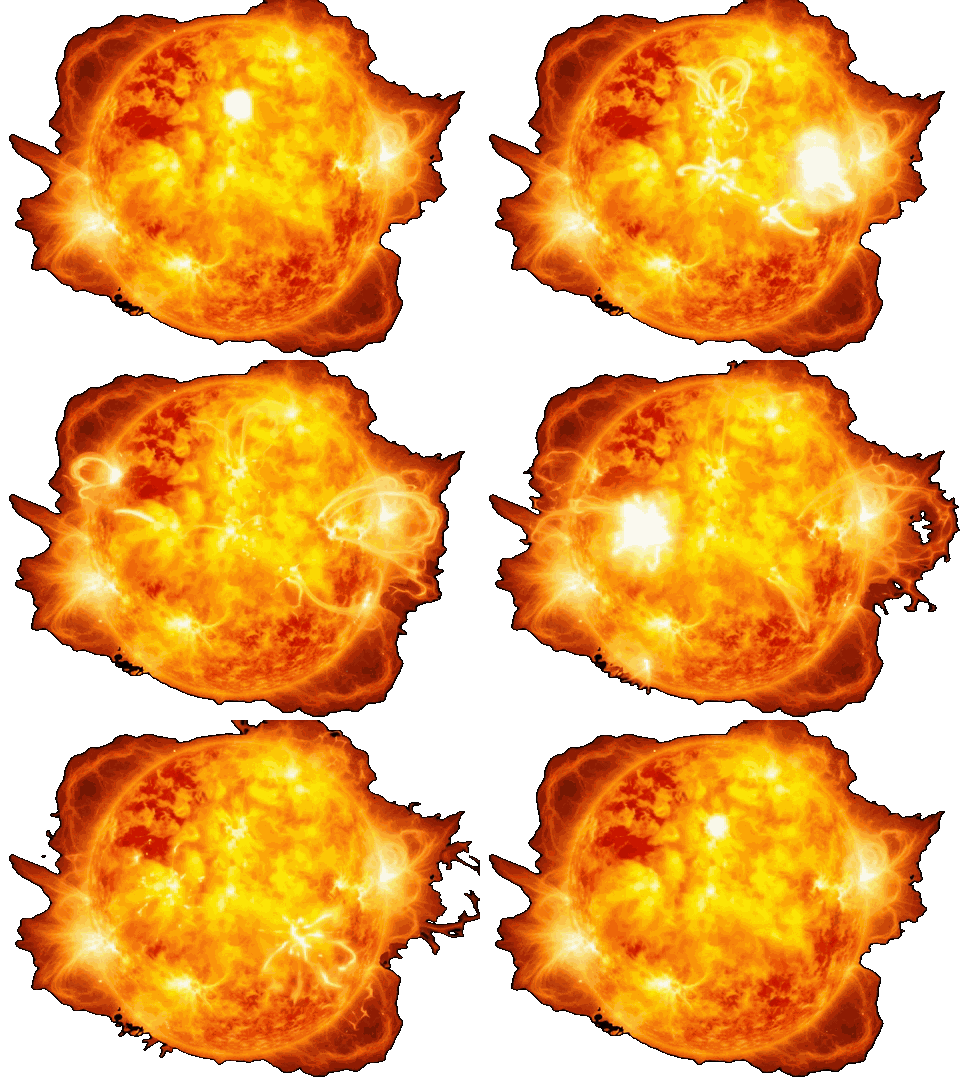










Sun


The Sun as viewed through a clear solar filter
|
|
| Names | Sun, Sol,[1] Sól, Helios[2] |
|---|---|
| Adjectives | Solar[3] |
| Symbol | .svg) |
| Observation data | |
| Mean distance from Earth | 1 au 149,600,000 km 8 min 19 s, light speed[4] |
| −26.74 (V)[5] | |
| 4.83[5] | |
| G2V[6] | |
| Metallicity | Z = 0.0122[7] |
| Angular size | 0.527°–0.545°[8] |
| Orbital characteristics | |
|
Mean distance from Milky Way core
|
24,000 to 28,000 light-years[9] |
| Galactic period | 225–250 million years |
| Velocity |
|
| Obliquity |
|
|
Right ascension North pole
|
286.13° (286° 7′ 48″)[5] |
|
Declination of North pole
|
+63.87° (63° 52′ 12″N)[5] |
|
Sidereal rotation period
|
|
|
Equatorial rotation velocity
|
1.997 km/s[11] |
| Physical characteristics | |
|
Equatorial radius
|
695,700 km[12] 109 × Earth radius[11] |
| Flattening | 0.00005[5] |
| Surface area | 6.09×10¹² km2 12,000 × Earth surface area[11] |
| Volume |
|
| Mass |
|
| Average density | 1.408 g/cm3 0.255 × Earth density[5][11] |
| Age | 4.6 billion years[14][15] |
|
Equatorial surface gravity
|
274 m/s2[5] 27.9 g0[11] |
| ~ 0.059[5] | |
|
Surface escape velocity
|
617.7 km/s 55 × Earth escape velocity[11] |
| Temperature |
|
| Luminosity | |
| Colour (B-V) | 0.656[16] |
| Mean radiance | 2.009×10⁷ W·m−2·sr−1 |
|
Photosphere composition by mass
|
|
The Sun is the star located at the centre of the Solar System. It is a massive sphere of hot plasma, heated to incandescence by nuclear fusion reactions in its core, radiating the energy from its surface mainly as visible light and infrared radiation with 10% at ultraviolet[18][19][20][21] energies. It is the main source of energy for life on Earth. The Sun has been an object of veneration in many cultures and a central subject of astronomical research since antiquity.
The Sun orbits the Galactic Center at a distance of 24,000 to 28,000 light-years. Its mean distance from Earth is about 1.496×10⁸ kilometres or about 8 light-minutes. The distance between the Sun and the Earth was used to define a unit of length called the astronomical unit (au), now defined to be 149.5978707×10⁶ kilometres. It is the largest and most massive object in the Solar System; its diameter is about 1,391,400 km (864,600 mi), around 109 times that of Earth. The Sun’s mass is around 330,000 times that of Earth, making up about 99.86% of the total mass of the Solar System. The mass of the Sun’s surface layer, its photosphere, consists mostly of hydrogen (~73%) and helium (~25%), with much smaller quantities of heavier elements, including oxygen, carbon, neon, and iron.
The Sun formed approximately 4.6 billion[a] years ago from the gravitational collapse of matter within a region of a large molecular cloud. Most of this matter gathered in the centre; the rest flattened into an orbiting disk that became the Solar System. The central mass became so hot and dense that it eventually initiated nuclear fusion in its core. It is now classified as a G-type main-sequence star (G2V). Every second, the Sun’s core fuses about 600 billion kilograms (kg) of hydrogen into helium and converts 4 billion kilograms of matter into energy.
About 4 to 7 billion years from now, when hydrogen fusion in the Sun’s core diminishes to the point where the Sun is no longer in hydrostatic equilibrium, its core will undergo a marked increase in density and temperature which will cause its outer layers to expand, eventually transforming the Sun into a red giant. After the red giant phase, models suggest the Sun will shed its outer layers and become a dense type of cooling star (a white dwarf), and no longer produce energy by fusion, but will still glow and give off heat from its previous fusion for perhaps trillions of years. After that, it is theorised to become an extremely dense black dwarf, giving off negligible energy.
Etymology
The English word sun developed from Old English sunne. Cognates appear in other Germanic languages, including West Frisian sinne, Dutch zon, Low German Sünn, Standard German Sonne, Bavarian Sunna, Old Norse sunna, and Gothic sunnō. All these words stem from Proto-Germanic *sunnōn.[22][23] This is ultimately related to the word for sun in other branches of the Indo-European language family, though in most cases a nominative stem with an l is found, rather than the genitive stem in n, as for example in Latin sōl, ancient Greek ἥλιος (hēlios), Welsh haul and Czech slunce, as well as (with *l > r) Sanskrit स्वर् (svár) and Persian خور (xvar). Indeed, the l-stem survived in Proto-Germanic as well, as *sōwelan, which gave rise to Gothic sauil (alongside sunnō) and Old Norse prosaic sól (alongside poetic sunna), and through it the words for sun in the modern Scandinavian languages: Swedish and Danish sol, Icelandic sól, etc.[23]
The principal adjectives for the Sun in English are sunny for sunlight and, in technical contexts, solar (/ˈsoʊlər/),[3] from Latin sol.[24] From the Greek helios comes the rare adjective heliac (/ˈhiːliæk/).[25] In English, the Greek and Latin words occur in poetry as personifications of the Sun, Helios (/ˈhiːliəs/) and Sol (/ˈsɒl/),[2][1] while in science fiction Sol may be used to distinguish the Sun from other stars. The term sol with a lowercase s is used by planetary astronomers for the duration of a solar day on another planet such as Mars.[26]
The astronomical symbol for the Sun is a circle with a central dot: ☉.[27] It is used for such units as M☉ (Solar mass), R☉ (Solar radius) and L☉ (Solar luminosity).[28][29] The scientific study of the Sun is called heliology.[30]
General characteristics
.jpg)
The Sun is a G-type main-sequence star that makes up about 99.86% of the mass of the Solar System.[31] The Sun is classed as a G2 star,[32] meaning it is a G-type star, with 2 indicating its surface temperature is in the second range of the G class. It has an absolute magnitude of +4.83, estimated to be brighter than about 85% of the stars in the Milky Way, most of which are red dwarfs.[33][34] It is more massive than 95% of the stars within 7 pc (23 ly).[35] The Sun is a Population I, or heavy-element-rich,[b] star.[36] Its formation approximately 4.6 billion years ago may have been triggered by shockwaves from one or more nearby supernovae.[37][38] This is suggested by a high abundance of heavy elements in the Solar System, such as gold and uranium, relative to the abundances of these elements in so-called Population II, heavy-element-poor, stars. The heavy elements could most plausibly have been produced by endothermic nuclear reactions during a supernova, or by transmutation through neutron absorption within a massive second-generation star.[36]
Shape
The Sun does not have a definite boundary, but its density decreases exponentially with increasing height above the photosphere.[39] For the purpose of measurement, the Sun’s radius is considered to be the distance from its centre to the edge of the photosphere, the apparent visible surface of the Sun.[40] The roundness of the Sun is the relative difference between its radius at its equator, Req, and at its pole, Rpol, called the oblateness,[41]


Δ⊙=(Req−Rpol)/Rpol.

The value is difficult to measure. Atmospheric distortion means the measurement must be done on satellites; the value is very small meaning very precise technique is needed.[42]
The oblateness was once proposed to be sufficient to explain the perihelion precession of Mercury but Einstein proposed that general relativity could explain the precession using a spherical Sun.[42] When high precision measurements of the oblateness became available via the Solar Dynamics Observatory[43] and the Picard satellite[41] the measured value was even smaller than expected,[42] 8.2×10⁻⁶, or 8 parts per million. These measurements determined the Sun to be the natural object closest to a perfect sphere ever observed.[44] The oblateness value remains constant independent of solar irradiation changes.[41] The tidal effect of the planets is weak and does not significantly affect the shape of the Sun.[45]
Rotation
The Sun rotates faster at its equator than at its poles. This differential rotation is caused by convective motion due to heat transport and the Coriolis force due to the Sun’s rotation. In a frame of reference defined by the stars, the rotational period is approximately 25.6 days at the equator and 33.5 days at the poles. Viewed from Earth as it orbits the Sun, the apparent rotational period of the Sun at its equator is about 28 days.[46] Viewed from a vantage point above its north pole, the Sun rotates counterclockwise around its axis of spin.[c][47]
A survey of solar analogues suggests the early Sun was rotating up to ten times faster than it does today. This would have made the surface much more active, with greater X-ray and UV emission. Sunspots would have covered 5%–30% of the surface.[48] The rotation rate was gradually slowed by magnetic braking, as the Sun’s magnetic field interacted with the outflowing solar wind.[49] A vestige of this rapid primordial rotation still survives at the Sun’s core, which rotates at a rate of once per week; four times the mean surface rotation rate.[50][51]
Composition
The Sun consists mainly of the elements hydrogen and helium. At this time in the Sun’s life, they account for 74.9% and 23.8%, respectively, of the mass of the Sun in the photosphere.[52] All heavier elements, called metals in astronomy, account for less than 2% of the mass, with oxygen (roughly 1% of the Sun’s mass), carbon (0.3%), neon (0.2%), and iron (0.2%) being the most abundant.[53]
The Sun’s original chemical composition was inherited from the interstellar medium out of which it formed. Originally it would have been about 71.1% hydrogen, 27.4% helium, and 1.5% heavier elements.[52] The hydrogen and most of the helium in the Sun would have been produced by Big Bang nucleosynthesis in the first 20 minutes of the universe, and the heavier elements were produced by previous generations of stars before the Sun was formed, and spread into the interstellar medium during the final stages of stellar life and by events such as supernovae.[54]
Since the Sun formed, the main fusion process has involved fusing hydrogen into helium. Over the past 4.6 billion years, the amount of helium and its location within the Sun has gradually changed. The proportion of helium within the core has increased from about 24% to about 60% due to fusion, and some of the helium and heavy elements have settled from the photosphere toward the centre of the Sun because of gravity. The proportions of heavier elements are unchanged. Heat is transferred outward from the Sun’s core by radiation rather than by convection (see Radiative zone below), so the fusion products are not lifted outward by heat; they remain in the core,[55] and gradually an inner core of helium has begun to form that cannot be fused because presently the Sun’s core is not hot or dense enough to fuse helium. In the current photosphere, the helium fraction is reduced, and the metallicity is only 84% of what it was in the protostellar phase (before nuclear fusion in the core started). In the future, helium will continue to accumulate in the core, and in about 5 billion years this gradual build-up will eventually cause the Sun to exit the main sequence and become a red giant.[56]
The chemical composition of the photosphere is normally considered representative of the composition of the primordial Solar System.[57] Typically, the solar heavy-element abundances described above are measured both by using spectroscopy of the Sun’s photosphere and by measuring abundances in meteorites that have never been heated to melting temperatures. These meteorites are thought to retain the composition of the protostellar Sun and are thus not affected by the settling of heavy elements. The two methods generally agree well.[58]
Structure

Core
The core of the Sun extends from the centre to about 20–25% of the solar radius.[59] It has a density of up to 150 g/cm3[60][61] (about 150 times the density of liquid water) and a temperature of close to 15.7 million kelvin (K).[61] By contrast, the Sun’s surface temperature is about 5800 K. Recent analysis of SOHO mission data favours the idea that the core is rotating faster than the radiative zone outside it.[59] Through most of the Sun’s life, energy has been produced by nuclear fusion in the core region through the proton–proton chain; this process converts hydrogen into helium.[62] Currently, 0.8% of the energy generated in the Sun comes from another sequence of fusion reactions called the CNO cycle; the proportion coming from the CNO cycle is expected to increase as the Sun becomes older and more luminous.[63][64]
The core is the only region of the Sun that produces an appreciable amount of thermal energy through fusion; 99% of the Sun’s power is generated in the innermost 24% of its radius, and almost no fusion occurs beyond 30% of the radius. The rest of the Sun is heated by this energy as it is transferred outward through many successive layers, finally to the solar photosphere where it escapes into space through radiation (photons) or advection (massive particles).[32][65]

The proton–proton chain occurs around 9.2×1037 times each second in the core, converting about 3.7×1038 protons into alpha particles (helium nuclei) every second (out of a total of ~8.9×1056 free protons in the Sun), or about 6.2×10¹¹ kg/s. However, each proton (on average) takes around 9 billion years to fuse with another using the PP chain.[32] Fusing four free protons (hydrogen nuclei) into a single alpha particle (helium nucleus) releases around 0.7% of the fused mass as energy,[66] so the Sun releases energy at the mass–energy conversion rate of 4.26 billion kg/s (which requires 600 billion kg of hydrogen[67]), for 384.6 yottawatts (3.846×1026 W),[5] or 9.192×10¹⁰ megatons of TNT per second. The large power output of the Sun is mainly due to the huge size and density of its core (compared to Earth and objects on Earth), with only a fairly small amount of power being generated per cubic metre. Theoretical models of the Sun’s interior indicate a maximum power density, or energy production, of approximately 276.5 watts per cubic metre at the centre of the core,[68] which, according to Karl Kruszelnicki, is about the same power density inside a compost pile.[69]
The fusion rate in the core is in a stable equilibrium: a slightly higher rate of fusion would cause the core to heat up more and expand slightly against the weight of the outer layers, reducing the density and hence the fusion rate and correcting the perturbation; and a slightly lower rate would cause the core to cool and shrink slightly, increasing the density and increasing the fusion rate and again reverting it to its present rate.[70]
Radiative zone

The radiative zone is the thickest layer of the Sun. It starts above the core at about 0.25 solar radii and out to about 0.7 solar radii. The zone is so named because thermal radiation is the primary means of energy transfer: photons scatter from dense gas so often that they take a million years to cross this zone.[71] The temperature drops from approximately 7 million to 2 million kelvins with increasing distance from the core.[61] This temperature gradient is less than the value of the adiabatic lapse rate and hence cannot drive convection, which explains why the transfer of energy through this zone is by radiation instead of thermal convection.[61] The density drops a hundredfold (from 20,000 kg/m3 to 200 kg/m3) between 0.25 solar radii and 0.7 radii, the top of the radiative zone.[71]
Tachocline
The radiative zone and the convective zone are separated by a transition layer, the tachocline. This is a region where the sharp regime change between the uniform rotation of the radiative zone and the differential rotation of the convection zone results in a large shear between the two—a condition where successive horizontal layers slide past one another.[72] Presently, it is hypothesised that a magnetic dynamo, or solar dynamo, within this layer generates the Sun’s magnetic field.[61]
Convective zone
The Sun’s convection zone extends from 0.7 solar radii (500,000 km) to near the surface. In this layer, the solar plasma is not dense or hot enough to transfer the heat energy of the interior outward via radiation. Instead, the density of the plasma is low enough to allow convective currents to develop and move the Sun’s energy outward towards its surface. Material heated at the tachocline picks up heat and expands, thereby reducing its density and allowing it to rise. As a result, an orderly motion of the mass develops into thermal cells that carry most of the heat outward to the Sun’s photosphere above. Once the material diffusively and radiatively cools just beneath the photospheric surface, its density increases, and it sinks to the base of the convection zone, where it again picks up heat from the top of the radiative zone and the convective cycle continues. At the photosphere, the temperature has dropped 350-fold to 5,700 K (9,800 °F) and the density to only 0.2 g/m3 (about 1/10,000 the density of air at sea level, and 1 millionth that of the inner layer of the convective zone).[61]
The thermal columns of the convection zone form an imprint on the surface of the Sun giving it a granular appearance called the solar granulation at the smallest scale and supergranulation at larger scales. Turbulent convection in this outer part of the solar interior sustains “small-scale” dynamo action over the near-surface volume of the Sun.[61] The Sun’s thermal columns are Bénard cells and take the shape of roughly hexagonal prisms.[73]
Atmosphere
The solar atmosphere is the region of the Sun that extends from the top of the convection zone to the inner boundary of the heliosphere. It is often divided into three primary layers: the photosphere, the chromosphere, and the corona.[74] The chromosphere and corona are separated by a thin transition region that is frequently considered as an additional distinct layer.[75]: 173–174 Some sources consider the heliosphere to be the outer or extended solar atmosphere.[76][77]
Photosphere
_as_of_January_20,_2020.jpg)
The visible surface of the Sun, the photosphere, is the layer below which the Sun becomes opaque to visible light.[78] Photons produced in this layer escape the Sun through the transparent solar atmosphere above it and become solar radiation, sunlight. The change in opacity is due to the decreasing amount of H− ions, which absorb visible light easily.[78] Conversely, the visible light perceived is produced as electrons react with hydrogen atoms to produce H− ions.[79][80]
The photosphere is tens to hundreds of kilometres thick, and is slightly less opaque than air on Earth. Because the upper part of the photosphere is cooler than the lower part, an image of the Sun appears brighter in the centre than on the edge or limb of the solar disk, in a phenomenon known as limb darkening.[78] The spectrum of sunlight has approximately the spectrum of a black-body radiating at 5,772 K (9,930 °F),[12] interspersed with atomic absorption lines from the tenuous layers above the photosphere. The photosphere has a particle density of ~1023 m−3 (about 0.37% of the particle number per volume of Earth’s atmosphere at sea level). The photosphere is not fully ionised—the extent of ionisation is about 3%, leaving most of the hydrogen in atomic form.[81]
The coolest layer of the Sun is a temperature minimum region extending to about 500 km above the photosphere, and has a temperature of about 4,100 K.[78] This part of the Sun is cool enough to allow for the existence of simple molecules such as carbon monoxide and water.[82]
Chromosphere
Above the temperature minimum layer is a layer about 2,000 km thick, dominated by a spectrum of emission and absorption lines.[78] It is called the chromosphere from the Greek root chroma, meaning colour, because the chromosphere is visible as a coloured flash at the beginning and end of total solar eclipses.[71] The temperature of the chromosphere increases gradually with altitude, ranging up to around 20,000 K near the top.[78] In the upper part of the chromosphere helium becomes partially ionised.[83]

The chromosphere and overlying corona are separated by a thin (about 200 km) transition region where the temperature rises rapidly from around 20,000 K in the upper chromosphere to coronal temperatures closer to 1,000,000 K.[84] The temperature increase is facilitated by the full ionisation of helium in the transition region, which significantly reduces radiative cooling of the plasma.[83] The transition region does not occur at a well-defined altitude, but forms a kind of nimbus around chromospheric features such as spicules and filaments, and is in constant, chaotic motion.[71] The transition region is not easily visible from Earth’s surface, but is readily observable from space by instruments sensitive to extreme ultraviolet.[85]
Corona
.jpg)
The corona is the next layer of the Sun. The low corona, near the surface of the Sun, has a particle density around 1015 m−3 to 1016 m−3.[83][d] The average temperature of the corona and solar wind is about 1,000,000–2,000,000 K; however, in the hottest regions it is 8,000,000–20,000,000 K.[84] Although no complete theory yet exists to account for the temperature of the corona, at least some of its heat is known to be from magnetic reconnection.[84][86]
The outer boundary of the corona is located where the radially increasing, large-scale solar wind speed is equal to the radially decreasing Alfvén wave phase speed. This defines a closed, nonspherical surface, referred to as the Alfvén critical surface, below which coronal flows are sub-Alfvénic and above which the solar wind is super-Alfvénic.[87] The height at which this transition occurs varies across space and with solar activity, reaching its lowest near solar minimum and its highest near solar maximum. In April 2021 the surface was crossed for the first time at heliocentric distances ranging from 16 to 20 solar radii by the Parker Solar Probe.[88][89] Predictions of its full possible extent have placed its full range within 8 to 30 solar radii.[90][91][92]
Heliosphere

The heliosphere is defined as the region of space where the solar wind dominates over the interstellar medium.[93] Turbulence and dynamic forces in the heliosphere cannot affect the shape of the solar corona within, because the information can only travel at the speed of Alfvén waves. The solar wind travels outward continuously through the heliosphere,[94][95] forming the solar magnetic field into a spiral shape,[86] until it impacts the heliopause more than 50 au (7.5 billion km) from the Sun. In December 2004, the Voyager 1 probe passed through a shock front that is thought to be part of the heliopause.[96] In late 2012, Voyager 1 recorded a marked increase in cosmic ray collisions and a sharp drop in lower energy particles from the solar wind, which suggested that the probe had passed through the heliopause and entered the interstellar medium,[97] and indeed did so on 25 August 2012, at approximately 122 au (18.3 billion km) from the Sun.[98] The heliosphere has a heliotail which stretches out behind it due to the Sun’s peculiar motion through the galaxy.[99]
Light, radiation, and observation

Energy from the Sun supports life on Earth by photosynthesis, allows vision in animals, and drives Earth’s climate and weather.[100][101] The Sun is by far the brightest object in the Earth’s sky, with an apparent magnitude of −26.74.[102][103] This is just less than 13 billion times brighter than the next brightest star, Sirius, which has an apparent magnitude of −1.46.[104]
The solar constant is the amount of power that the Sun deposits per unit area that is directly exposed to sunlight. The solar constant is equal to approximately 1,368 W/m2 (watts per square metre) at a distance of one astronomical unit (au) from the Sun (that is, at or near Earth’s orbit).[105] Sunlight on the surface of Earth is attenuated by Earth’s atmosphere, so that less power arrives at the surface, closer to 1,000 W/m2 (in clear conditions when the Sun is near the zenith).[106] Sunlight at the top of Earth’s atmosphere is composed (by total energy) of about 50% infrared light, 40% visible light, and 10% ultraviolet light.[107] The atmosphere filters out over 70% of solar ultraviolet, especially at the shorter wavelengths.[108]
Visible light and observation
The Sun’s colour is white, with a CIE colour-space index near (0.3, 0.3), when viewed from space or when the Sun is high in the sky. The Solar radiance per wavelength peaks in the green portion of the spectrum when viewed from space.[109][110] When the Sun is very low in the sky, atmospheric scattering renders the Sun yellow, red, orange, or magenta, and in rare occasions even green or blue. Some cultures mentally picture the Sun as yellow and some even red; the cultural reasons for this are debated.[111]
An optical phenomenon, known as a green flash, can sometimes be seen shortly after sunset or before sunrise. The flash is caused by light from the Sun just below the horizon being bent (usually through a temperature inversion) towards the observer. Light of shorter wavelengths (violet, blue, green) is bent more than that of longer wavelengths (yellow, orange, red) but the violet and blue light is scattered more, leaving light that is perceived as green.[112]
Exposure to the eye
.jpg)
The brightness of the Sun can cause pain from looking at it with the naked eye; however, doing so for brief periods is not hazardous for normal non-dilated eyes.[113][114] Looking directly at the Sun, known as sungazing, causes phosphene visual artefacts and temporary partial blindness. It also delivers about 4 milliwatts of sunlight to the retina, slightly heating it and potentially causing damage in eyes that cannot respond properly to the brightness.[115][116] Viewing of the direct Sun with the naked eye can cause UV-induced, sunburn-like lesions on the retina beginning after about 100 seconds, particularly under conditions where the UV light is intense and focused.[117][118]
Viewing the Sun through light-concentrating optics such as binoculars may result in permanent damage to the retina without an appropriate filter. Some improvised filters that pass UV or IR rays can harm the eye at high brightness levels.[119] Brief glances at the midday Sun through an unfiltered telescope can cause permanent damage.[120]
During sunrise and sunset, sunlight is attenuated because of Rayleigh scattering and Mie scattering from a particularly long passage through Earth’s atmosphere,[121] and the Sun is sometimes faint enough to be viewed comfortably with the naked eye or safely with optics (provided there is no risk of bright sunlight suddenly appearing through a break between clouds). Hazy conditions, atmospheric dust, and high humidity contribute to this atmospheric attenuation.[122]
Other radiation
Solar ultraviolet radiation ionises Earth’s dayside upper atmosphere, creating its electrically conducting ionosphere.[123] This radiation causes sunburn, and has other biological effects such as the production of vitamin D and sun tanning. It is the main cause of skin cancer. Ultraviolet light is strongly attenuated by Earth’s ozone layer, so that the amount of UV varies greatly with latitude and has been partially responsible for many biological adaptations, including variations in human skin colour.[124] Ultraviolet light from the Sun has antiseptic properties and can be used to sanitise tools and water.
High-energy gamma ray photons initially released with fusion reactions in the core are almost immediately absorbed by the solar plasma of the radiative zone, usually after travelling only a few millimetres. Re-emission happens in a random direction and usually at slightly lower energy. With this sequence of emissions and absorptions, it takes a long time for radiation to reach the Sun’s surface. Estimates of the photon travel time range between 10,000 and 170,000 years.[125] In contrast, it takes only 2.3 seconds for neutrinos, which account for about 2% of the total energy production of the Sun, to reach the surface. Because energy transport in the Sun is a process that involves photons in thermodynamic equilibrium with matter, the time scale of energy transport in the Sun is longer, on the order of 30,000,000 years. This is the time it would take the Sun to return to a stable state if the rate of energy generation in its core were suddenly changed.[126]
Electron neutrinos are released by fusion reactions in the core, but, unlike photons, they rarely interact with matter, so almost all are able to escape the Sun immediately. However, measurements of the number of these neutrinos produced in the Sun are lower than theories predict by a factor of 3. In 2001, the discovery of neutrino oscillation resolved the discrepancy: the Sun emits the number of electron neutrinos predicted by the theory, but neutrino detectors were missing 2⁄3 of them because the neutrinos had changed flavour by the time they were detected.[127]
Magnetic activity
The Sun has a stellar magnetic field that varies across its surface. Its polar field is 1–2 gauss (0.0001–0.0002 T), whereas the field is typically 3,000 gauss (0.3 T) in features on the Sun called sunspots and 10–100 gauss (0.001–0.01 T) in solar prominences.[5] The magnetic field varies in time and location. The quasi-periodic 11-year solar cycle is the most prominent variation in which the number and size of sunspots waxes and wanes.[128][129][130]
The solar magnetic field extends well beyond the Sun itself. The electrically conducting solar wind plasma carries the Sun’s magnetic field into space, forming what is called the interplanetary magnetic field.[86] In an approximation known as ideal magnetohydrodynamics, plasma only moves along magnetic field lines. As a result, the outward-flowing solar wind stretches the interplanetary magnetic field outward, forcing it into a roughly radial structure. For a simple dipolar solar magnetic field, with opposite hemispherical polarities on either side of the solar magnetic equator, a thin current sheet is formed in the solar wind. At great distances, the rotation of the Sun twists the dipolar magnetic field and corresponding current sheet into an Archimedean spiral structure called the Parker spiral.[86]
Sunspots

Sunspots are visible as dark patches on the Sun’s photosphere and correspond to concentrations of magnetic field where convective transport of heat is inhibited from the solar interior to the surface. As a result, sunspots are slightly cooler than the surrounding photosphere, so they appear dark. At a typical solar minimum, few sunspots are visible, and occasionally none can be seen at all. Those that do appear are at high solar latitudes. As the solar cycle progresses toward its maximum, sunspots tend to form closer to the solar equator, a phenomenon known as Spörer’s law. The largest sunspots can be tens of thousands of kilometres across.[131]
An 11-year sunspot cycle is half of a 22-year Babcock–Leighton dynamo cycle, which corresponds to an oscillatory exchange of energy between toroidal and poloidal solar magnetic fields. At solar-cycle maximum, the external poloidal dipolar magnetic field is near its dynamo-cycle minimum strength; but an internal toroidal quadrupolar field, generated through differential rotation within the tachocline, is near its maximum strength. At this point in the dynamo cycle, buoyant upwelling within the convective zone forces emergence of the toroidal magnetic field through the photosphere, giving rise to pairs of sunspots, roughly aligned east–west and having footprints with opposite magnetic polarities. The magnetic polarity of sunspot pairs alternates every solar cycle, a phenomenon described by Hale’s law.[132][133]
During the solar cycle’s declining phase, energy shifts from the internal toroidal magnetic field to the external poloidal field, and sunspots diminish in number and size. At solar-cycle minimum, the toroidal field is, correspondingly, at minimum strength, sunspots are relatively rare, and the poloidal field is at its maximum strength. With the rise of the next 11-year sunspot cycle, differential rotation shifts magnetic energy back from the poloidal to the toroidal field, but with a polarity that is opposite to the previous cycle. The process carries on continuously, and in an idealised, simplified scenario, each 11-year sunspot cycle corresponds to a change, then, in the overall polarity of the Sun’s large-scale magnetic field.[134][135]
Solar activity

The Sun’s magnetic field leads to many effects that are collectively called solar activity. Solar flares and coronal mass ejections tend to occur at sunspot groups. Slowly changing high-speed streams of solar wind are emitted from coronal holes at the photospheric surface. Both coronal mass ejections and high-speed streams of solar wind carry plasma and the interplanetary magnetic field outward into the Solar System.[136] The effects of solar activity on Earth include auroras at moderate to high latitudes and the disruption of radio communications and electric power. Solar activity is thought to have played a large role in the formation and evolution of the Solar System.[137]
Changes in solar irradiance over the 11-year solar cycle have been correlated with changes in sunspot number.[138] The solar cycle influences space weather conditions, including those surrounding Earth. For example, in the 17th century, the solar cycle appeared to have stopped entirely for several decades; few sunspots were observed during a period known as the Maunder minimum. This coincided in time with the era of the Little Ice Age, when Europe experienced unusually cold temperatures.[139][140] Earlier extended minima have been discovered through analysis of tree rings and appear to have coincided with lower-than-average global temperatures.[141]
Coronal heating
The temperature of the photosphere is approximately 6,000 K, whereas the temperature of the corona reaches 1,000,000–2,000,000 K.[84] The high temperature of the corona shows that it is heated by something other than direct heat conduction from the photosphere.[86]
It is thought that the energy necessary to heat the corona is provided by turbulent motion in the convection zone below the photosphere, and two main mechanisms have been proposed to explain coronal heating.[84] The first is wave heating, in which sound, gravitational or magnetohydrodynamic waves are produced by turbulence in the convection zone.[84] These waves travel upward and dissipate in the corona, depositing their energy in the ambient matter in the form of heat.[142] The other is magnetic heating, in which magnetic energy is continuously built up by photospheric motion and released through magnetic reconnection in the form of large solar flares and myriad similar but smaller events—nanoflares.[143]
Currently, it is unclear whether waves are an efficient heating mechanism. All waves except Alfvén waves have been found to dissipate or refract before reaching the corona.[144] In addition, Alfvén waves do not easily dissipate in the corona. The current research focus has therefore shifted toward flare heating mechanisms.[84]